Runs stats::kmeans() on the samples x taxa abundance matrix, with
nstart = 10 random starts so that the partition is stable, and with the
random number generator seeded by seed so that it is reproducible.
Arguments
- biom
An rbiom object, or any value accepted by
as_rbiom().- rank
Which taxa rank to use. E.g.
"Phylum","Genus",".otu", etc. An integer can also be given, where1is the highest rank,2is the second highest,-1is the lowest rank,-2is the second lowest, and0is the OTU "rank". Runbiom$ranksto see all options for a given rbiom object. Default:.otu.- k
Number of clusters. Default:
5L- seed
Random seed for the k-means starting centers. Default:
0- ...
Passed on to
stats::kmeans().
See also
Other taxa_abundance:
sample_sums(),
taxa_boxplot(),
taxa_corrplot(),
taxa_da(),
taxa_forest(),
taxa_heatmap(),
taxa_stacked(),
taxa_stats(),
taxa_sums(),
taxa_table()
Other clustering:
bdiv_clusters()
Examples
    library(rbiom)

    biom <- rarefy(hmp50)
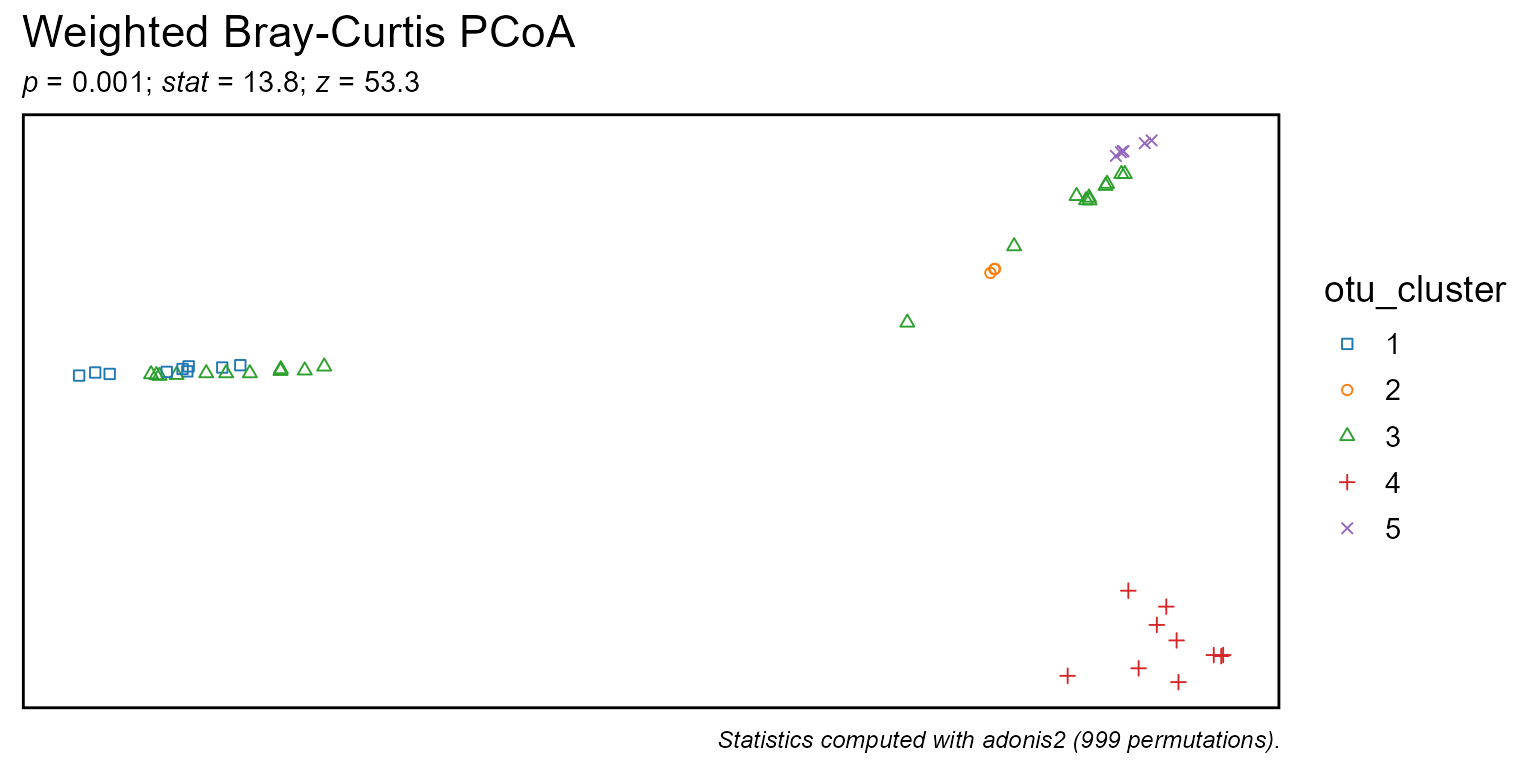
    biom$metadata$otu_cluster <- taxa_clusters(biom)

    pull(biom, 'otu_cluster')[1:10]
#> HMP01 HMP02 HMP03 HMP04 HMP05 HMP06 HMP07 HMP08 HMP09 HMP10
#>     3     3     2     2     3     2     3     2     2     4
#> Levels: 1 2 3 4 5

    bdiv_ord_plot(biom, layers = "p", stat.by = "otu_cluster")